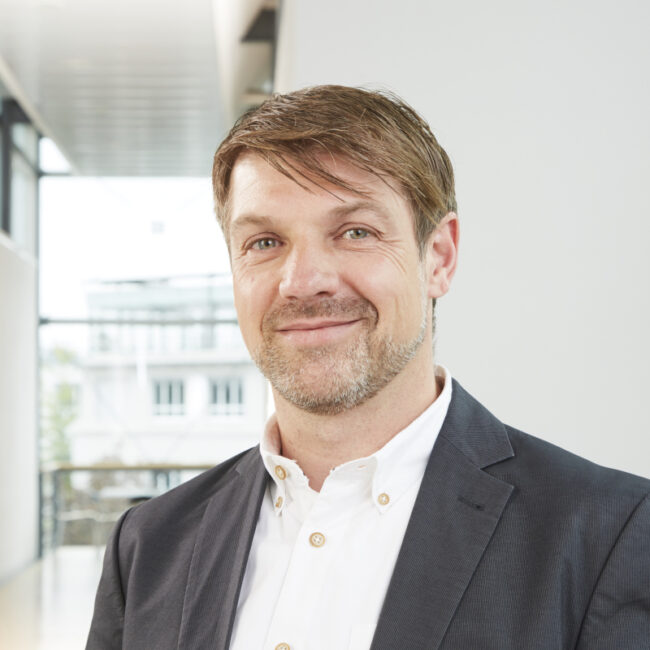
Robert Szolak is researching ways to convert green electricity into green molecules such as dimethyl ether (DME).
The German Federal Ministry of Research, Technology and Space has dedicated its Science Year 2025 to solutions and ideas in energy research. For us at Europe’s largest solar research institute, this has been part of our DNA since 1981. That’s why we asked our colleagues what #FutureEnergy plays a special role in their everyday work. In this (mainly German) blog series, we introduce our researchers, their projects, and their personal views on energy and the energy transition.
Robert Szolak is a department head at Fraunhofer ISE and, together with his colleagues, researches solutions for converting green electricity into green molecules such as ammonia or dimethyl ether. The research team is investigating the most efficient, cost-effective, and sustainable ways to produce, transport, and, if necessary, convert them back into hydrogen. In addition, the experts are developing environmentally friendly aviation and marine fuels and new concepts for capturing CO2 from the air (direct air capture).
Which future technology are you enthusiastic about? Why?
Hydrogen technologies are crucial for transforming the energy system in order to slow down climate change and achieve climate targets. According to the national hydrogen strategy, Germany will import around 50–70% of its hydrogen and its derivatives, either via pipelines from neighboring countries or by ship in the form of ammonia, methanol, or dimethyl ether.
I consider dimethyl ether (DME) to be a very interesting molecule in this regard. It is known as the propellant in deodorant spray cans. But DME can do more: it is an environmentally friendly alternative to diesel, liquefied petroleum gas, and CFCs and can be used as an intermediate product for the production of sustainable aviation fuels. DME is an important building block for the hydrogen economy, as it can be used as an efficient hydrogen carrier for its transport. Unlike ammonia, dimethyl ether is non-toxic and can be liquefied without consuming much energy.
At Fraunhofer ISE, we have developed a process that greatly increases the overall efficiency of converting renewable energy into DME compared to the conventional, complex, and energy-intensive process: The new process uses reactive distillation, which bypasses the thermodynamic reaction equilibrium by coupling synthesis and distillation, reducing energy requirements, plant complexity, and investment costs. As a result, the process has 39 percent lower overall costs than the conventional process.
Robert Szolak Head of Department “Sustainable Synthesis Products” at Fraunhofer ISE
You are the head of the Power-to-MEDME research project. What contribution does the project make with regards to future energies?
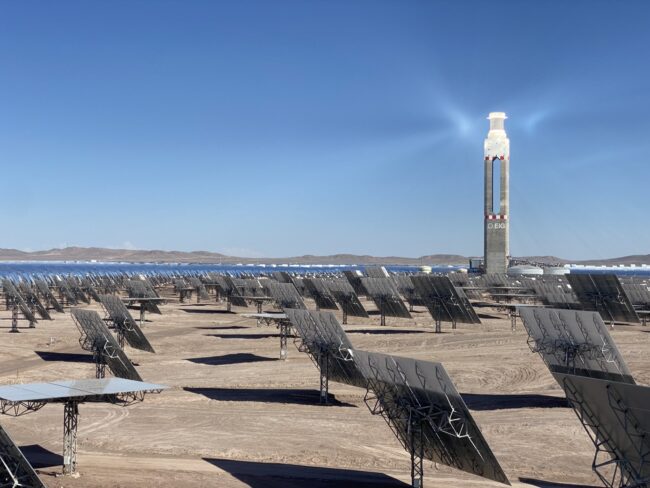
“Power-to-MEDME” is one of our many exciting projects. We are collaborating with international partners such as Fraunhofer CSET in Chile and other research institutions. In this project, we are analyzing the large-scale production of green hydrogen carriers such as dimethyl ether in Chile. It encompasses tasks along the entire process chain, starting with the production of green hydrogen from solar energy, through CO2 capture from a cement plant, to the DME product, with the aim of reducing costs and increasing the efficiency of the various processes themselves. As part of the project, we have further developed the efficient process described above for the production of renewable DME and successfully set it up and operated it on a pilot scale. Chile offers unique geographical and climatic conditions, especially in the north, making it ideal for the production of power-to-X technologies. DME production will not only serve the domestic market, but also position Chile as a major exporter of clean fuels to Europe and Asia. This pilot plant could not only represent a milestone on the road to climate neutrality, but also an opportunity for Chile to strengthen its role in the global renewable energy market.
I want to make a significant contribution to the energy transition through innovation and new technologies. Hydrogen and hydrogen-based substances such as dimethyl ether enable the storage, trading, and transport of renewable electricity. By converting them into liquid fuels such as methanol and sustainable aviation fuels, the mobility sector can be freed from fossil fuels. In addition, hydrogen and its derivatives can be used in the industrial sector to generate high-temperature process heat. Through our research work, we are making a major contribution and developing new, efficient, and cost-effective technologies. At Fraunhofer ISE, we always work closely with partners from industry to put our ideas into practice. This collaboration makes Fraunhofer unique and allows us to be “right at the heart of the action.” That’s what motivates and inspires me in my work.
Which scientific fact about the energy transition should everyone know?
The electricity production costs of renewable energies have fallen sharply over the last 25 years. The average electricity production costs for solar and wind power are significantly lower than those for fossil fuel-based power generation. Switching to green electricity and green molecules to achieve climate targets therefore makes sense not only from an ecological perspective, but also from an economic one.
What gives you personal energy?
In international exchanges with researchers, industry representatives, and politicians, for example at our international workshops, it becomes clear time and again that the energy transition can only succeed if it is thought of in global terms. In most countries, there is a consensus and a commitment to reducing greenhouse gas emissions. If everyone pulls together now, we can achieve a great deal. Working on technologies that accelerate this reduction motivates me and gives me energy.
Fraunhofer ISE is participating in Science Year 2025 – Future Energy with this blog series as well as other activities and events. All of our contributions can be found on our German Website
The editorial team of Innovation4E maintains this blog.
We support our bloggers in the identification of topics, conduct interviews and garner ideas for further contents. We are looking forward to questions, suggestions, comments and constructive criticism.
Do you have questions or remarks? Any interesting topics that you would like to read about in the future? We are happy to answer your questions and hear your suggestions about “Innovation4E”.

 Innovation 4E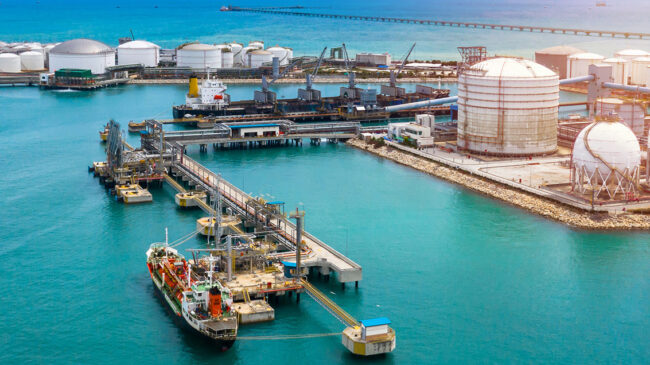

 Ramy Essam
 Sebastian Kaiser
 André Sternberg
 Karl-Anders Weiß
 Timo Kurz
 José Fernandez
 Alexander Theis



Add comment