
 Wolfgang Kramer
Industry faces a major challenge: In the coming decades, processes must be converted from fossil fuels to renewable energy. Transformation concepts offer companies a clear roadmap for how decarbonization can be implemented quickly, reliably, and at a manageable cost – while combining sustainability with economic efficiency. It is crucial to take variable boundary conditions into account, such as fluctuating energy costs and the availability of renewable energy. Electrification, in particular, is gaining importance, for example through photovoltaics, waste heat utilization with heat pumps, or power-to-heat solutions.
A consistent, integrated methodology is essential for implementing decarbonization concepts in a cost-effective and targeted manner. Experience from our project work at Fraunhofer ISE shows that with the right tools, CO₂ emissions can be significantly and economically reduced – with manageable effort for concept development. When we develop transformation concepts for companies, we proceed as follows:
Assessing the status quo
In the first step, we identify all individual measures for process optimization. These include improving the efficiency of electrical consumers such as fans, motors, and lighting, as well as process engineering adjustments – for example, lowering process temperatures or making fundamental changes to the workflow. This creates a solid foundation for further planning.
Key: the “pinch” analysis
The “pinch” analysis is a key tool for process integration. It enables us to identify efficient and cost-effective concepts for direct heat recovery or the use of heat pumps. The goal of a “pinch” analysis is to optimally connect heat sources and sinks via heat exchangers in order to utilize waste heat internally. Crucial to this is the cascaded use of waste heat according to temperature levels: waste heat is always utilized at the highest possible temperature level to fully exploit its energy potential. The result of the “pinch” analysis is an overview of how heating and cooling demands can be optimally coupled.
Based on the analysis, technologies such as solar thermal, combined heat and power, heat pumps, or thermal storage can be integrated into a model. This allows our customers to identify which heating and cooling demands need to be considered and which integration points are suitable for heat pumps and storage systems. Additionally, the effects of individual measures on total energy demand become apparent. With a systematic “pinch” analysis, energy efficiency can be increased to the point where up to 40% of energy can be saved.
Simulate operating strategies and component design
Using dynamic simulation, we realistically model temporal fluctuations in loads, generators, and storage systems. This allows for the precise sizing of process heating and cooling systems, providing investment security for companies and avoiding over- or undersizing. Various operating strategies can also be simulated, for instance, in response to production changes or new temperature requirements. The “ColSim” simulation tool we developed at Fraunhofer ISE is specifically designed for such dynamic analyses.
Optimizing the energy supply
In the final step, we further develop the heating and cooling demand system – which has been optimized through “pinch” analysis and simulation – using energy system analysis. In doing so, we incorporate all available energy sources (electricity, hydrogen, biomass, natural gas) as well as various technologies (e.g., photovoltaics, combined heat and power, power-to-heat, solar thermal, battery storage) and time-varying energy prices. It is crucial to consider energy carrier prices and availability in order to create a long-term sustainable transformation plan. For this task, we have access to the Fraunhofer ISE tool “District”.
Examples
Koehler Paper
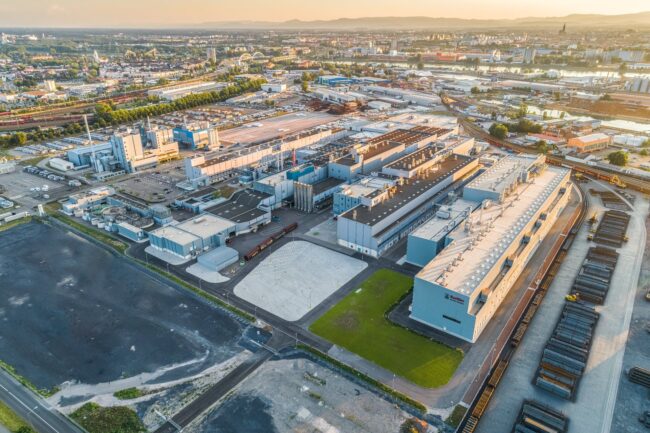
At Koehler Paper’s Kehl site, we were able to identify ways to drastically reduce natural gas consumption. In doing so, we identified optimization potential for the entire property, including paper machines and the on-site power plant. We also examined the potential connection to a district heating network, enabling us to develop concepts for steam generation using heat pumps in addition to heat recovery with heat exchangers.
Adelholzener Alpenquellen GmbH
For Adelholzener Alpenquellen GmbH, we developed a concept that enables the complete elimination of energy-related CO₂ emissions. In addition to improved direct heat recovery, we integrated industrial heat pumps. Key elements include the use of waste heat from the refrigeration system and wastewater with large-scale heat pumps, the optimization of internal heat recovery, and the use of thermal storage.
Our work demonstrates that “pinch” analysis is ideally suited for identifying measures to reduce CO₂ emissions for heating and cooling in industry. Combined with dynamic process simulation and energy system modeling, it enables the development and evaluation of concepts for technologies such as heat pumps, solar thermal systems, thermal storage, and CHP plants – always taking technical and economic aspects into account.
At Fraunhofer ISE, we develop innovative solutions to support the transition towards a climate-neutral industry. Our research focuses on the integration of renewable energies, the improvement of energy efficiency and the use of waste heat in industrial processes. By combining technological development, process optimization, and comprehensive consulting, we help companies reduce their emissions and make their production processes future-proof.
Funding Opportunities for Transformation Plans
For companies in Baden-Württemberg:
Through the “Energy Roadmap” funding call issued by the Ministry of the Environment, Climate Protection, and Energy, financial grants are available for professional consulting services – including systemic analysis of energy flows, identification of efficiency and decarbonization potential, and the development of a practical roadmap with concrete measures, cost estimates, and savings projections.
Baden-Württemberg Energy Roadmap Funding Program (in German)
Nationwide Funding:
Transformation plans can be funded nationwide through the Federal Office for Economic Affairs and Export Control (BAFA).
Funding for Transformation Plans (in German)
Cover Picture: © iStock.com / www.industrieblick.net
 Ramy Essam
 Sven Auerswald
 Simon Gölzhäuser
 Innovation 4E


 Moritz Ihlenburg
 Mona Mühlich



Add comment