
 Ramy Essam
Despite green hydrogen’s significant potential as a versatile molecule for defossilizing hard-to-abate sectors where direct electrification remains challenging, the market ramp-up of green Hydrogen (H2) based on renewable electricity and its derivatives has lagged due to high upfront capital investment costs (CAPEX), elevated levelized costs of production (LCoX) and an underdeveloped regulatory framework. These barriers have slowed commercial deployment relative to climate targets.
Meanwhile, abundant biogenic CO₂ sources and waste streams – from biogas plants, bioethanol plants, landfill plants, wastewater treatment plants, and biomass processing – offer strong near-term potential but remain largely underutilized for low-carbon molecules production. Through the thermal utilization of these sources (via upgrading or reforming), sustainable H₂ can be produced in addition to CO₂. Together, these two molecules form the basic building blocks for the synthesis of sustainable hydrocarbons. Unlocking this potential can help overcome current cost and deployment barriers associated with the production of molecules for the aviation, maritime, and chemical industries. By valorizing methane-rich (CH₄) biogenic gases alongside green Hydrogen, they achieve substantial reductions in greenhouse gases (GHG), CAPEX and LCoX by leveraging existing infrastructure and mature technologies.
Innovation4E interviewed Dr. Ramy Essam, researcher and project manager at Fraunhofer ISE about his work on low carbon molecules and their potential.
Dr. Essam, you work on production pathways for low-carbon molecules from biogenic CO2 sources. What is your main focus?
We develop and evaluate innovative production routes for low-carbon molecules from biogenic sources and waste streams. The term “low-carbon molecules” refers to various synthetic energy carriers and chemicals that can replace fossil energy carriers and chemicals with less net CO2 emissions during their production, distribution and use and thus are very important for industries that need to reduce their carbon footprint.
My work focuses on process development, techno-economic assessment, and identifying production pathways for methanol, dimethyl ether (DME), and sustainable aviation fuel (SAF) in a scalable and economically viable way.
One of your recent research projects was called “SHIFT”. What was it about and what role does it place in advancing low-carbon molecules?
The ”SHIFT” project is one of our many exciting initiatives. We collaborate with international research institutions, including Fraunhofer CSET in Chile. Within the project, we evaluated existing biogenic CO₂ sources in Chile for the production of low-carbon molecules. This work focused on sector-coupled systems for heat, industry, fuels, and transport, assessing the potential to integrate renewable energy with sustainable chemical production at scale, with the goal of reducing costs and improving efficiency across the value chain.
SHIFT identified first-mover concepts through systematic process evaluation. We assessed biogenic- and biomass-derived routes to methanol, DME, and SAF via methanol-to-jet (MtJ), based on real case studies using low-cost biogenic CO₂ with favorable CH₄/CO₂ ratios.
Process simulation, design and optimization of syngas gas production were carried out, along with the evaluation of downstream synthesis to identify scalable and cost-effective solutions. A techno-economic assessment quantified production costs, complemented bysite mapping to identify locations with optimal feedstock access, infrastructure, and off-taker proximity. We have since applied this methodology in a wide range of countries and regions to identify the most promising sites for so-called power-to-X and bio-to-X hybrid concepts on behalf of our clients.
Which technology do you find most promising for the near term?
Methanol is an attractive option, as it serves effectively as an intermediate chemical feedstock, liquid fuel, and energy carrier, while leveraging existing infrastructure. Among the available routes, the biogas-to-bio-methanol route stands out as a near-term solution: it allows immediate deployment using existing biogenic CO₂ sources, helping to fill the gap while green hydrogen technologies are scaled up. Our preliminary techno-economic analyses indicate about a 30% reduction in CAPEX compared to conventional Power-to-X (PtX) routes, i.e., typical production processes for synthetic energy carriers and chemicals based on green hydrogen. This makes the biogas-based pathway attractive and feasible even today.
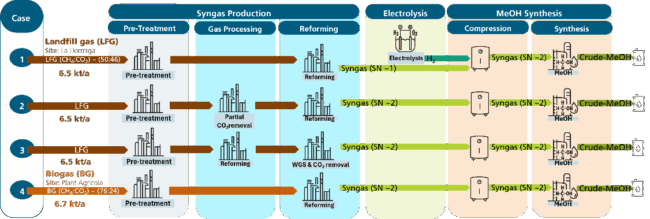
Conversion of biogenic gas sources in Chile to bio-based methanol. Two plants with varying CH₄/CO₂ ratios: Cases 1-3 landfill gas (La Hormiga), Case 4 biogas (Plant Agrícola). Process variations include syngas production by reforming reaction, additional H₂ via electrolysis, CO₂ removal from feed, and H₂ increase by Water-Gas Shift Reaction (WGS) combined with CO₂ removal.
Why did you choose energy research as your career path?
I chose energy research because I wanted to contribute to practical applied R&D solutions that make a real difference today. I really enjoy working where research meets industry and real-world implementation, turning concepts into affordable solutions that industries can adopt. Being binational has sharpened my perspective. I see great potential in linking Egypt’s (my previous homeland) strong renewable energy resources with Germany’s (my current homeland) technological expertise and deployment capacity, building intercontinental energy partnerships and contributing to a more sustainable future for everyone.
Where do you see the biggest opportunities for future development?
The biggest opportunities lie in using biogenic CO2 sources and waste streams systematically for low-carbon molecules production and in integrating renewable energy with existing industrial infrastructure. That combination can reduce emissions, lower costs, and accelerate deployment in hard-to-abate sectors (e.g. maritime sector). The concepts described also make an important contribution to the circular economy by enabling CO₂ to be returned to the material cycle and helping to close the carbon cycle as much as possible. Solutions must be region-specific: solar with storage in sunny areas like MENA and Latin America, offshore wind in Northern Europe, geothermal and hydropower where possible, green hydrogen, low-carbon molecules, and e-fuels for hard-to-abate sectors. Deploying the right mix quickly, with collaboration, is key to reaching net zero.
Our project “Power-to-X Colombia” provides a practical example. The modelling results form the basis for targeted pilot and flagship projects for the production of low-carbon methanol. One identified flagship concept is based on the utilization of landfill gas from the Cartagena region as a feedstock source, supported by local partnerships, feedstock integration, and access to industrial off-takers. This highlights how our work extends beyond modelling and techno-economic assessment by supporting the development of pilot and demonstration projects.
At Fraunhofer ISE, we develop innovative solutions to support the transition towards a climate-neutral industry. Our research focuses on the integration of renewable energies, the improvement of energy efficiency and the use of waste heat in industrial processes. By combining technological development, process optimization, and comprehensive consulting, we help companies reduce their emissions and make their production processes future-proof.
Further Information
- Process Simulation for Innovative Industrial Processes
- Sector Coupled Systems for Heat, Industry, Fuels and Transport in Chile”SHIFT”
- Power-to-X Colombia – Green Hydrogen and Derivatives Production
- LNG2Hydrogen – TransHyDE project for converting LNG terminals to hydrogen-based energy sources
Cover Picture: © iStock.com / CHUNYIP WONG, Graph Fraunhofer ISE

 Sven Auerswald
 Innovation 4E
 Wolfgang Kramer
 Simon Gölzhäuser


 Moritz Ihlenburg



Add comment